Mar 11, 2013

Hướng dẫn cấu hình Router Cisco Loadbalancing trên 2 tuyến FTTH

1. Cấu hình Interface kết nối 2 tuyến FTTH
CISCO(config)#int g0/0
CISCO(config-if)#description #FTTH FPT#
CISCO(config-if)#pppoe enable group global
CISCO(config-if)#pppoe-client dial-pool-number 1
CISCO(config-if)#no shut
 CISCO(config)#int g0/1
CISCO(config-if)#description #FTTH VNPT#
CISCO(config-if)#pppoe enable group global
CISCO(config-if)#pppoe-client dial-pool-number 2
CISCO(config-if)#no shut CISCO(config)#dialer-list 1 protocol ip permit
2. Khai báo thông tin chứng thực 2 tuyến FTTH 
CISCO(config)#int dialer 1
CISCO(config-if)#description #FTTH FPT#
CISCO(config-if)#ip address negotiated
CISCO(config-if)#ip mtu 1492
CISCO(config-if)#ip nat outside
CISCO(config-if)#encapsulation ppp
CISCO(config-if)#dialer pool 1
CISCO(config-if)#dialer-group 1
CISCO(config-if)#ppp pap sent-username password 0 
CISCO(config-if)#no shut 
CISCO(config-if)#exit 
 CISCO(config)#int dialer 2 
CISCO(config-if)#description #FTTH VNPT# 
CISCO(config-if)#ip address negotiated 
CISCO(config-if)#ip mtu 1492 
CISCO(config-if)#ip nat outside 
CISCO(config-if)#encapsulation ppp 
CISCO(config-if)#dialer pool 2 
CISCO(config-if)#dialer-group 1 
CISCO(config-if)#ppp pap sent-username password 0 
CISCO(config-if)#no shut 
CISCO(config-if)#exit
3. Cấu hình Loadbalancing 
CISCO(config)#track 1 interface Dialer1 ip routing 
CISCO(config-track)#delay down 5 up 10 
CISCO(config)#track 2 interface Dialer2 ip routing 
CISCO(config-track)#delay down 5 up 10 
CISCO(config)#route-map nat1 permit 10 
CISCO(config-route-map)#match interface Dialer1 
CISCO(config-route-map)#set interface Dialer1 
CISCO(config)#route-map nat2 permit 20 
CISCO(config-route-map)#match interface Dialer2 
CISCO(config-route-map)#set interface Dialer2 
CISCO(config)#ip nat inside source route-map nat1 interface Dialer1 overload 
CISCO(config)#ip nat inside source route-map nat2 interface Dialer2 overload 
CISCO(config)#ip route 0.0.0.0 0.0.0.0 Dialer1 track 1 
CISCO(config)#ip route 0.0.0.0 0.0.0.0 Dialer2 track 2

Read more »

Feb 27, 2013

How can we limit the bandwidth on Cisco router ?


We have a router, f0/0 will be for the Internet connection with bandwidth of 30Mbps.
Its f0/1 will be connected to a switch for internal networks.
This link will be separated to 3 VLANs for 3 internal networks.
Is there is a way to guarantee 10Mbps for each VLAN but allow use up to 30Mbps when another two VLANs are not using any Internet bandwidth?
We worry about download bandwidth from internet.

The 3 internal networks will all have public IPs and they belong to their own subnets. There won't be NAT/PAT. Is there a sample config. available?

The following example polices the inside interface to 30Mbps. It also utilizes a fair queue mechanism so that all subnets are queued equally yet can use the entire purchased rate in the absence of competing traffic.

Command:

access-list 101 permit ip any a.a.a.a w.w.w.w ## Subnet A

access-list 102 permit ip any b.b.b.b w.w.w.w ## Subnet B

access-list 103 permit ip any c.c.c.c w.w.w.w ## Subnet C

class-map subnet-a
match access-group 101

class-map subnet-b
match access-group 102

class-map subnet-c
match access-group 103

policy-map subnets
class-map subnet-a
bandwidth percent 33
class-map subnet-b
bandwidth percent 33
class-map subnet-c
bandwidth percent 33
exit

policy-map physical
class class-default
police 30000000 conform-action transmit exceed-action drop
service-policy subnets
exit

int fa0/1
service-policy output physical
exit

    The parent policy (physical) limits the traffic to 30Mbps. The child policy (subnets) allocates 33% of available bandwidth to each subnet. In this case it should be very close to 10Mbps for each subnet. This is a fair queue mechanism so it will only enforce the 10Mbps limit if all subnets are in contention with each other. If subnet A and B are idle subnet C can take all 30Mbps.

    A it to the physical interface should affect all traffic traversing that interface; which includes all sub-interfaces. Please click here for an example.

    If this techniques doesn't support 1800 you could police each sub-interface. This would ensure good service for everyone but leave bandwidth unused and unavailable during idle times.

Read more »

Video Introduction to New CCNAv5.0 Curriculum


CCNAv5.0........
As previously announced, NetAcad is releasing a new version of our CCNA curriculum this year. We are delighted to share an exciting video introduction to the new CCNA curriculum with you. This is one of many communications we will be sending over the coming months to provide regular updates on our progress and share more in-depth information, including the scope and sequence, equipment requirements, and phase release plans.
You told us what you wanted and we listened. This short video begins with an animation that captures the essence of how the flexibility of the new CCNA curriculum will enable you to accommodate diverse student learning goals and personalize the courses to fit your own teaching style.
As a reminder, we are targeting phased releases of the new CCNA courses starting in June 2013, with all courses to be available by December 2013. Thank you for your continued collaboration as we bring you this exciting new version of CCNA.
The new CCNA curriculum represents the future of Mind Wide Open teaching and learning.
Join us in the new CCNA experience.


Read more »

Aug 6, 2012

CCNA 2 Chapter 1 V4.0 Answers Updated 2012


1.Which two statements correctly describe the components of a router? (Choose two.) 

RAM permanently stores the configuration file used during the boot sequence.

ROM contains diagnostics executed on hardware modules.

NVRAM stores a backup copy of the IOS used during the boot sequence.

Flash memory does not lose its contents during a reboot.

ROM contains the most current and most complete version of the IOS.

Flash contains boot system commands to identify the location of the IOS.

2.Which interfaces in the exhibit could be used for a leased line WAN connection? (Choose two.) 


1

2

3

4

5

6

3.If a router cannot find a valid configuration file during the startup sequence, what will occur?

The startup sequence will reset.

The router will prompt the user for a response to enter setup mode.

The startup sequence will halt until a valid configuration file is acquired.

The router will generate a default configuration file based on the last valid configuration.

The router will monitor local traffic to determine routing protocol configuration requirements.

4.Which of the following is the correct flow of routines for a router startup? 

load bootstrap, load IOS, apply configuration

load bootstrap, apply configuration, load IOS

load IOS, load bootstrap, apply configuration, check hardware

check hardware, apply configuration, load bootstrap, load IOS

5.What is the default sequence for loading the configuration file? 

NVRAM, FLASH, ROM

FLASH, TFTP,CONSOLE

NVRAM, TFTP, CONSOLE

FLASH, TFTP, ROM

6.From what location can a router load the Cisco IOS during the boot process? (Choose two.) 

RAM

TFTP server

NVRAM

setup routine

Flash memory

terminal

7.Which are functions of a router? (Choose three.) 

packet switching

extension of network segments

segmentation of broadcast domains

selection of best path based on logical addressing

selection of best path based on physical addressing

8.What three processes does a router execute when it receives a packet from one network that is destined for another network? (Choose three.) 

decapsulates the Layer 3 packet by stripping off the Layer 2 frame header

uses the destination MAC Address in the IP Header to look up the next-hop address in the routing table

leaves the Layer 2 frame header intact when decapsulating the Layer 3 packet

uses the destination IP Address in the IP header to look up the next-hop address in the routing table

encapsulates the Layer 3 packet into the new Layer 2 frame and forwards it out the exit interface

encapsulates the Layer 3 packet into a special Layer 1 frame and forwards it to the exit interface

9.The network administrator needs to connect two routers directly via their FastEthernet ports. What cable should the network administrator use?

straight-through

rollover

cross-over

serial

10.Refer to the exhibit.

What can be concluded from the output of the running-configuration of a router? 

The passwords are encrypted.

The current configuration was saved to NVRAM.

The configuration that is shown will be the one used on the next reboot.

The commands that are displayed determine the current operation of the router.

11.Which two statements describe characteristics of load balancing? (Choose two.) 

Load balancing occurs when a router sends the same packet to different destination networks.

Load balancing occurs when the same number of packets are sent over static and dynamic routes.

Load balancing allows a router to forward packets over multiple paths to the same destination network.

Unequal cost load balancing is supported by EIGRP.

If multiple paths with different metrics to a destinations exist, the router cannot support load balancing.

12.Refer to the exhibit. 


What can be concluded from the routing table output in the exhibit? (Choose two.) 

This router only has two interfaces.

The router interfaces are not operational yet.

This router is configured to forward packets to remote networks.

The FastEthernet0/0 and Serial0/0/0 interfaces of this router were configured with an IP address and the no shutdown command.

An IP packet received by this router with a destination address of 198.18.8.2 will be forwarded out of the Serial0/0/0 interface.

13.The serial connection shown in the graphic needs to be configured. Which configuration commands must be made on the Sydney router to establish connectivity with the Melbourne site? (Choose three.) 


Sydney(config-if)# ip address 201.100.53.2 255.255.255.0

Sydney(config-if)# no shutdown

Sydney(config-if)# ip address 201.100.53.1 255.255.255.224

Sydney(config-if)# clock rate 56000

Sydney(config-if)# ip host Melbourne 201.100.53.2

14.Passwords can be used to restrict access to all or parts of the Cisco IOS. Select the modes and interfaces that can be protected with passwords. (Choose three.) 

VTY interface

console interface

Ethernet interface

secret EXEC mode

privileged EXEC mode

router configuration mode

15.What is the outcome of entering these commands?
R1(config)# line vty 0 4 
R1(config-line)# password check123 
R1(config-line)# login 

ensures that a password is entered before entering user EXEC mode

sets the password to be used for connecting to this router via Telnet

requires check123 to be entered before the configuration can be saved

creates a local user account for logging in to a router or switch


16.Refer to the exhibit.

The network administrator has configured the router with the interface IP addresses shown for the directly connected networks. Pings from the router to hosts on the connected networks or pings between router interfaces are not working. What is the most likely problem? 

The destination networks do not exist.

The IP addresses on the router interfaces must be configured as network addresses and not host addresses.

The interfaces must be enabled with the no shutdown command.

Each interface must be configured with the clock rate command.

17.A network administrator has just entered new configurations into Router1. Which command should be executed to save configuration changes to NVRAM? 

Router1# copy running-config flash

Router1(config)# copy running-config flash

Router1# copy running-config startup-config

Router1(config)# copy running-config startup-config

Router1# copy startup-config running-config

Router1(config)# copy startup-config running-config


18.Refer to the exhibit. 


All routers have a route in its routing table to each network that is shown in the exhibit. Default routes have not been issued on these routers. What can be concluded about how packets are forwarded in this network? (Choose two.) 

If RouterC receives a packet that is destined for 10.5.1.1, it will be forwarded out interface Fa0/0.

If RouterA receives a packet that is destined for 192.168.3.146, it will be forwarded out interface S0/0/1.

If RouterB receives a packet that is destined for 10.5.27.15, it will be forwarded out interface S0/0/1.

If RouterB receives a packet that is destined for 172.20.255.1, it will be forwarded out interface S0/0/0.

If RouterC receives a packet that is destined for 192.16.5.101, it will be forwarded out interface S0/0/1.


19.What header address information does a router change in the information it receives from an attached Ethernet interface before information is transmitted out another interface? 

only the Layer 2 source address

only the Layer 2 destination address

only the Layer 3 source address

only the Layer 3 destination address

the Layer 2 source and destination address

the Layer 3 source and destination address


20.Refer to the exhibit. 


Host A pings host B. When R4 accepts the ping into the Ethernet interface, what two pieces of header information are included? (Choose two.) 

source IP address: 192.168.10.129

source IP address: BBBB.3333.5677

source MAC address: 5555.AAAA.6666

destination IP address: 192.168.10.33

destination IP address: 192.168.10.134

destination MAC address: 9999.DADC.1234

21.Refer to the exhibit. 


After host 2 is connected to the switch on the LAN, host 2 is unable to communicate with host 1. What is the cause of this problem? 

The subnet mask of host 2 is incorrect.

Host 1 and host 2 are on different networks.

The switch needs an IP address that is not configured.

The router LAN interface and host 1 are on different networks.

The IP address of host 1 is on a different network than is the LAN interface of the router.

Read more »

Jul 24, 2012

CCNA 1 Final Answers Updated 2012

DOWN LOAD CCNA 1 FINAL ANSWER FULL 

1.As network administrator, what is the subnet mask that allows 510 hosts given the IP address 172.30.0.0? 

255.255.0.0

255.255.248.0

255.255.252.0

255.255.254.0

255.255.255.0

255.255.255.128

2.Which combination of network id and subnet mask correctly identifies all IP addresses from 172.16.128.0 through 172.16.159.255? 

172.16.128.0 255.255.255.224

172.16.128.0 255.255.0.0

172.16.128.0 255.255.192.0

172.16.128.0 255.255.224.0

172.16.128.0 255.255.255.192

3.Which two functions of the OSI model occur at layer two? (Choose two.) 

physical addressing

encoding

routing

cabling

media access control

4.Refer to the exhibit. 


On the basis of the IP configuration that is shown, what is the reason that Host A and Host B are unable to communicate outside the local network? 

Host A was assigned a network address.

Host B was assigned a multicast address.

Host A and Host B belong to different networks.

The gateway address was assigned a broadcast address.


5.Refer to the exhibit.

What is the correct destination socket number for a web page request from Host A to the web server? 

00-08-a3-b6-ce-46

198.133.219.25:80

http://www.cisco.com

6.The Layer 4 header contains which type of information to aid in the delivery of data? 

service port number

host logical address

device physical address

virtual connection identifier
 
7.Refer to the exhibit.

The network containing router B is experiencing problems. A network associate has isolated the issue in this network to router B. What action can be preformed to correct the network issue? 

issue the clock rate command on interface Serial 0/0/0

issue the description command on interface Serial 0/0/1

issue the ip address command on interface FastEthernet 0/0

issue the no shutdown command on interface FastEthernet 0/1


8.Refer to the exhibit.

Which set of devices contains only intermediary devices? 

A, B, D, G

A, B, E, F

C, D, G, I

G, H, I, J


9.When connectionless protocols are implemented at the lower layers of the OSI model, what is usually used to acknowledge that the data was received and to request the retransmission of missing data? 

IP

UDP

Ethernet

a connectionless acknowledgement

an upper-layer, connection-oriented protocol or service
 
10.Which OSI layer uses a connection-oriented protocol to ensure reliable delivery of data? 

application layer

presentation layer

session layer

transport layer


Read more »

Jul 19, 2012

CCNA 3 Chapter 5 V4.0 Answers Updated 2012

1.What is the first step in the process of convergence in a spanning tree topology?
election of the root bridge
blocking of the non-designated ports
selection of the designated trunk port
determination of the designated port for each segment

2.Refer to the exhibit.

The spanning-tree port priority of each interface is at the default setting. The network administrator enters the spanning-tree vlan 1 root primary command on S4. What is the effect of the command?
Spanning tree blocks Gi0/1 on S3.
Gi0/2 on S3 transitions to a root port.
Port priority makes Gi0/2 on S1 a root port.
S4 is already the root bridge, so there are no port changes.

3.Which two statements are true about the default operation of STP in a Layer 2 switched environment that has redundant connections between switches? (Choose two.)
The root switch is the switch with the highest speed ports.
Decisions on which port to block when two ports have equal cost depend on the port priority and identity.
All trunking ports are designated and not blocked.
Root switches have all ports set as root ports.
Non-root switches each have only one root port.

4.What three link types have been defined for Rapid Spanning-Tree Protocol? (Choose three.)
shared
end-to-end
edge-type
boundary-type
point-to-many
point-to-point

5.What two features of the Spanning-Tree Protocol contribute to the time it takes for a switched network to converge after a topology change occurs? (Choose two.)
the max-age timer
the spanning-tree hold down timer
the forward delay
the spanning-tree path cost
the blocking delay

6.What Rapid Spanning Tree Protocol (RSTP) role is assigned to the forwarding port elected for every Ethernet LAN segment that links two switches?
alternate
backup
designated
edge

7.How can a network administrator influence which STP switch becomes the root bridge?
Configure all the interfaces on the switch as the static root ports.
Change the BPDU to a lower value than that of the other switches in the network.
Assign a lower IP address to the switch than that of the other switches in the network.
Set the switch priority to a smaller value than that of the other switches in the network.

8.Which statement or set of paired statements correctly compares STP with RSTP?
STP and RSTP have the same BPDU format and flag field information.
STP specifies backup ports. RSTP has only root ports, alternate ports, and designated ports.
STP port states are independent of port roles. RSTP ties together the port state and port role.
STP waits for the network to converge before placing ports into forwarding state. RSTP places designated ports into forwarding state immediately.

9.Which two statements describe the BIDs used in a spanning tree topology? (Choose two.)
They are sent out by the root bridge only after the inferior BPDUs are sent.
They consist of a bridge priority and MAC address.
Only the root bridge will send out a BID.
They are used by the switches in a spanning tree topology to elect the root bridge.
The switch with the fastest processor will have the lowest BID.

10.In which STP state does a port record MAC addresses but not forward user data?
blocking
learning
disabling
listening
forwarding
11.What two elements will exist in a converged network with one spanning tree? (Choose two.)
one root bridge per network
all non-designated ports forwarding
one root port per non-root bridge
multiple designated ports per segment
one designated port per network

12.Which two items are true regarding the spanning-tree portfast command? (Choose two.)
PortFast is Cisco proprietary.
PortFast can negatively effect DHCP services.
PortFast is used to more quickly prevent and eliminate bridging loops.
Enabling PortFast on trunks that connect to other switches improves convergence.
If an access port is configured with PortFast, it immediately transitions from a blocking to a forwarding state.

13.Refer to the exhibit.

What can be determined from the output shown?
Two hosts communicating between ports Fa0/2 and Fa0/4 have a cost of 38.
The priority was statically configured to identify the root.
STP is disabled on this switch.
The timers have been altered to reduce convergence time.

14.Which two criteria does a switch use to select the root bridge? (Choose two.)
bridge priority
switching speed
number of ports
base MAC address
switch location
memory size

15.Refer to the exhibit.

Server sends an ARP request for the MAC address of its default gateway. If STP is not enabled, what will be the result of this ARP request?
Router_1 will drop the broadcast and reply with the MAC address of the next hop router.
Switch_A will reply with the MAC address of the Router_1 E0 interface.
Switch_A and Switch_B will continuously flood the message onto the network.
The message will cycle around the network until its TTL is exceeded.

16.Which three statements are accurate regarding RSTP and STP? (Choose three.)
RSTP uses a faster algorithm to determine root ports.
RSTP introduced the extended system ID to allow for more than 4096 VLANs.
Both RSTP and STP use the portfast command to allow ports to immediately transition to forwarding state.
Like STP PortFast, an RSTP edge port that receives a BPDU loses its edge port status immediately and becomes a normal spanning-tree port.
Configuration commands to establish primary and secondary root bridges are identical for STP and RSTP.
Because of the format of the BPDU packet, RSTP is backward compatible with STP.

17.In which two ways is the information that is contained in BPDUs used by switches? (Choose two.)
to negotiate a trunk between switches
to set the duplex mode of a redundant link
to identify the shortest path to the root bridge
to prevent loops by sharing bridging tables between connected switches
to determine which ports will forward frames as part of the spanning tree

18.Refer to the exhibit. 


All switches in the network have empty MAC tables. STP has been disabled on the switches in the network. How will a broadcast frame that is sent by host PC1 be handled on the network?
Switch SW1 will block the broadcast and drop the frame.
Switch SW1 will forward the broadcast out all switch ports, except the originating port. This will generate an endless loop in the network.
Switch SW1 will forward the broadcast out all switch ports, except the originating port. All hosts in the network will reply with a unicast frame sent to host PC1.
Switch SW1 will forward the traffic out all switch ports except the originating port as a unicast frame. All hosts in the network will reply with a unicast frame sent to switch SW1.

19.Which two actions does an RSTP edge port take if it receives a BPDU? (Choose two.)
immediately loses its edge status
inhibits the generation of a TCN
goes immediately to a learning state
disables itself
becomes a normal spanning-tree port

20.When PVST+ was developed, the Bridge ID was modified to include which information?
bridge priority
MAC address
protocol
VLAN ID

Read more »

CCNA 3 Chapter 4 V4.0 Answers Updated 2012

1.Which statement is true when VTP is configured on a switched network that incorporates VLANs?
VTP is only compatible with the 802.1Q standard.
VTP adds to the complexity of managing a switched network.
VTP allows a switch to be configured to belong to more than one VTP domain.
VTP dynamically communicates VLAN changes to all switches in the same VTP domain.

2.What are two features of VTP client mode operation? (Choose two.)
unable to add VLANs
can add VLANs of local significance
forward broadcasts out all ports with no respect to VLAN information
can only pass VLAN management information without adopting changes
can forward VLAN information to other switches in the same VTP domain

3.Refer to the exhibit.

Switch S1 is in VTP server mode. Switches S2 and S3 are in client mode. An administrator accidentally disconnects the cable from F0/1 on S2. What will the effect be on S2?
S2 will retain the VLANs as of the latest known revision.
S2 will automatically transition to VTP transparent mode.
S2 will remove all VLANs from the VLAN database until the cable is reconnected.
S2 will automatically send a VTP request advertisement to 172.17.99.11 when the cable is reconnected.

4.Refer to the exhibit. 


All switches in the VTP domain are new. Switch SW1 is configured as a VTP server, switches SW2 and SW4 are configured as VTP clients, and switch SW3 is configured in VTP transparent mode. Which switch or switches receive VTP updates and synchronize their VLAN configuration based on those updates?
All switches receive updates and synchronize VLAN information.
Only switch SW2 receives updates and synchronizes VLAN information.
Only switches SW3 and SW4 receive updates and synchronize VLAN information.
SW3 and SW4 receive updates, but only switch SW4 synchronizes VLAN information.

5.Refer to the exhibit. 


The switches in the exhibit are connected with trunks within the same VTP management domain. Each switch is labeled with its VTP mode. A new VLAN is added to Switch3. This VLAN does not show up on the other switches. What is the reason for this?
VLANs cannot be created on transparent mode switches.
Transparent mode switches do not forward VTP advertisements.
VLANs created on transparent mode switches are not included in VTP advertisements.
Server mode switches neither listen to nor forward VTP messages from transparent mode switches.

6.Refer to the exhibit. 


S2 was previously used in a lab environment and has been added to the production network in server mode. The lab and production networks use the same VTP domain name, so the network administrator made no configuration changes to S2 before adding it to the production network. The lab domain has a higher revision number. After S2 was added to the production network, many computers lost network connectivity. What will solve the problem?
Reset the revision number on S2 with either the delete VTP command or by changing the domain name and then changing it back.
Reset each switch back to an earlier configuration and then re-enter all appropriate VLANs, except VLAN 1, manually on Switch1 so that they propagate throughout the network.
Change S1 to transparent VTP mode to reclaim all VLANs in vlan.dat and change back to server mode.
Change S2 to client mode so the VLANs will automatically propagate.


7.Which two events will cause the VTP revision number on a VTP server to change? (Choose two.)
adding VLANs
rebooting the switch
changing the VTP domain name
changing the switch to a VTP client
changing interface VLAN designations

8.What causes a VTP configured switch to issue a summary advertisement?
A five-minute update timer has elapsed.
A port on the switch has been shutdown.
The switch is changed to the transparent mode.
A new host has been attached to a switch in the management domain.

9.Which two statements are true about VTP pruning? (Choose two.)
Pruning is enabled by default.
Pruning can only be configured on VTP servers.
Pruning must be configured on all VTP servers in the domain.
VLANs on VTP client-mode switches will not be pruned.
Pruning will prevent unnecessary flooding of broadcasts across trunks.

10.Which three VTP parameters must be identical on all switches to participate in the same VTP domain? (Choose three.)
revision number
domain name
pruning
mode
domain password
version number
11.Refer to the exhibit. 


All switches in the network participate in the same VTP domain. What happens when the new switch SW2 with a default configuration and revision number of 0 is inserted in the existing VTP domain Lab_Network?
The switch operates as a VTP client.
The switch operates in VTP transparent mode.
The switch operates as a VTP server and deletes the existing VLAN configuration in the domain.
The switch operates as a VTP server, but does not impact the existing VLAN configuration in the domain.
The switch operates as a VTP server in the default VTP domain and does not affect the configuration in the existing VTP domain.

12.Refer to the exhibit.

Switches SW1 and SW2 are interconnected via a trunk link but failed to exchange VLAN information. The network administrator issued the show vtp status command to troubleshoot the problem. On the basis of the provided command output, what could be done to correct the problem?
Switch SW2 must be configured as a VTP client.
The switches must be interconnected via an access link.
The switches must be configured with the same VTP domain name.
Both switches must be configured with the same VTP revision number.

13.Refer to the exhibit.


Switch1 is not participating in the VTP management process with the other switches that are shown in the exhibit. What are two possible explanations for this? (Choose two.)
Switch1 is in client mode.
Switch2 is in server mode.
Switch2 is in transparent mode.
Switch1 is in a different management domain.
Switch1 has end devices that are connected to the ports.
Switch1 is using VTP version 1, and Switch2 is using VTP version 2.

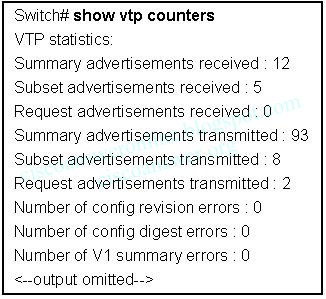
14.Refer to the exhibit. 


Which two facts can be confirmed by this output? (Choose two.)
If this switch is added to an established network, the other VTP-enabled switches in the same VTP domain will consider their own VLAN information to be more recent than the VLAN information advertised by this switch.
This switch shows no configuration revision errors.
This switch has established two-way communication with the neighboring devices.
This switch is configured to advertise its VLAN configuration to other VTP-enabled switches in the same VTP domain.
This switch is configured to allows the network manager to maximize bandwidth by restricting traffic to specific network devices.

15.Refer to the exhibit.

What information can be learned from the output provided?
It verifies the configured VTP password.
It verifies the VTP domain is configured to use VTP version 2.
It verifies VTP advertisements are being exchanged.
It verifies the VTP domain name is V1.

16.Which two statements describe VTP transparent mode operation? (Choose two.)
Transparent mode switches can create VLAN management information.
Transparent mode switches can add VLANs of local significance only.
Transparent mode switches pass any VLAN management information that they receive to other switches.
Transparent mode switches can adopt VLAN management changes that are received from other switches.
Transparent mode switches originate updates about the status of their VLANS and inform other switches about that status.

17.Which two statements are true about the implementation of VTP? (Choose two.)
Switches must be connected via trunks.
The VTP domain name is case sensitive.
Transparent mode switches cannot be configured with new VLANs.
The VTP password is mandatory and case sensitive.
Switches that use VTP must have the same switch name.

18.A network administrator is replacing a failed switch with a switch that was previously on the network. What precautionary step should the administrator take on the replacement switch to avoid incorrect VLAN information from propagating through the network?
Enable VTP pruning.
Change the VTP domain name.
Change the VTP mode to client.
Change all the interfaces on the switch to access ports.

19.What does a client mode switch in a VTP management domain do when it receives a summary advertisement with a revision number higher than its current revision number?
It suspends forwarding until a subset advertisement update arrives.
It issues an advertisement request for new VLAN information.
It increments the revision number and forwards it to other switches.
It deletes the VLANs not included in the summary advertisement.
It issues summary advertisements to advise other switches of status changes.

20.How are VTP messages sent between switches in a domain?
Layer 2 broadcast
Layer 2 multicast
Layer 2 unicast
Layer 3 broadcast
Layer 3 multicast
Layer 3 unicast

Read more »